
Sizing Natural Gas Regulators
Are you searching for a natural gas regulator? Or do you want to learn how to size a gas regulator? In either case, you’ve come to the right place. As a leading stocking distributor of regulators, we’re happy to share what you need to know to select the correct regulator for your applications. Of course, if you’re in the market for a regulator, message us:
4 Gas Regulator Types
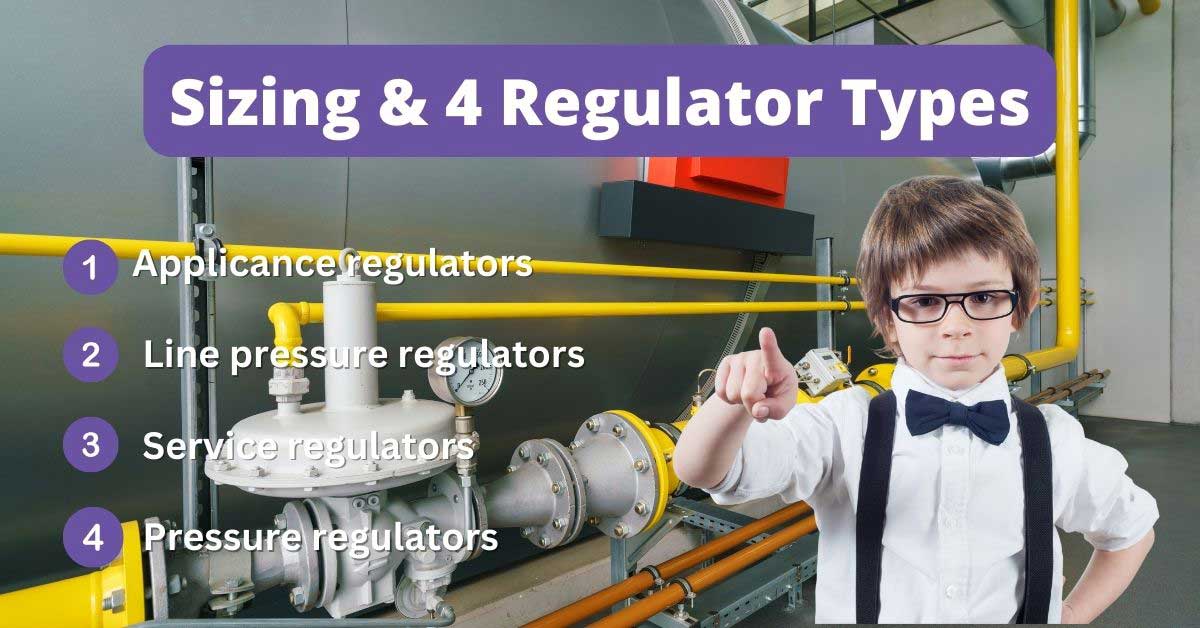
Before sizing, understand the regulator’s purpose. There are four primary applications for gas regulators:
- Appliance regulators control the gas pressure running to an appliance.
- Line gas regulators control the gas pressure between a service regulator and an appliance regulator on a gas line.
- Service regulators reduce service line gas pressure to the desired delivery pressure.
- Pressure regulators reduce, control, and maintain the pressure of a specific portion of a pipe system.
Sizing Cheat Sheet
Click the image to download the infographic PDF.
7 Things You Need for Natural Gas Regulator Sizing
To select a natural gas regulator, here are the seven things you need to know to size your natural gas regulator:
- Gas type – What type of gas are you regulating? While most customers inquire about natural gas or methane, we also help control propane (LPG).
- Inlet and outlet pressure – What is the inlet and desired outlet pressure? The units of measure here are either PSIG or WC. If you do not have a pressure gauge, you can always call your gas distributor or inquire about some of our excellent gauges (gages) available.
- Gas flow – What are the gas load and capacity? What are the minimum and maximum expected capacities in BTU/hr? Or CFH?
- Flow is typically expressed in CFH (cubic feet per hour or CFM (minute)
- 1 CF = one cubic foot of gas = 1,000 Btu
- 1 CFH = one cubic foot of gas per hour = 1,000 Btu/hour
- 100 CF = 100,000 Btu = 1 Therm
- Pipe size – What is the pipe size? Regulators are typically available in ½” through 4″.
- Altitude – Altitude affects regulator sizing. Atmospheric pressure reduces with altitude, so we must ascertain the regulator’s intended elevation. Learn more about the effects of altitude.
- Location – Is the regulator to be indoors or outdoors? Consider a line pressure regulator with a vent limiter and an overpressure protection device (OPD) if indoors. Learn more about Gas Line Pressure versus Appliance Control regulators.
- Noise – Is noise an issue? Or vibrations? Humming, buzzing, chugging, and vibrations can occur for various reasons (harmonic instability, hunting, feedback) in a gas system.
Selecting the Correct Unit for an Application
If you have the answers to the seven items mentioned above, you have what you need to select the correct regulator. Call us at 303 697-6701 – or message us – and we will gladly assist you with sizing your application.
Regulator Manufacturers’ Sizing Tools
Some manufacturers offer sizing programs on their websites. Here is an example:
Are you looking for Gas Pressure Regulators?
We offer our clients the best products for their commercial, industrial, and utility market needs. We typically stock regulators from:
- BelGAS
- Itron (formerly Actaris, Schlumberger, Sprague)
- Maxitrol
- Honeywell (formerly Elster American Meter, Gorter)
- Dungs
Please message us if you don’t see what you are looking for, as we cannot publish all product offerings. See our Sales Team page if you want to connect with a salesperson.






Hi
I have a natural gas well on my farm
Has been for over 80 years.
They use it to heat hose and run gas lights.
Then just just a hot water heater.
They told me it lost it pressure.
I unhooked it from house from a regulator and found it has 21psi.
We hooked up to a paint regulator
Cutting the pressure down as low as we could hook up to a natural gas furnace and it burned very clean, and the durance cycled.
Question; need to know how or what size of regulator I will need to cut pressure down from 21psi in to about 3psi to run a 120 btu boiler?
LPG is also knowns as Liquefied Petroleum Gas or Liquid Petroleum Gas. LPG is simply a mixture of hydrocarbon gases like propane or butane etc are commonly used as fuel in heating appliances, hospitality, calefaction, construction, sailing and fishing sectors, and vehicles. It is used as an aerosol propellant and a refrigerant. Liquefied Petroleum Gas is mainly for cooking in many countries for economic reasons because is is one of the best-preferred fuel sources.
I am really impressed after reading this blog post. I would like to thank you for sharing this amazing post with us and i will share it too.
The Gas Pressure Regulators market was valued at Million US$ in 2017 and is projected to reach Million US$ by 2025, at a CAGR of during the forecast period. In this study, 2017 has been considered as the base year and 2018 to 2025 as the forecast period to estimate the market size for Gas Pressure Regulators.
Pipe Size. Is that the required outlet pipe size? If so, is there typically a pipe transition on the inlet to a regulator due to the inlet pipe being smaller than the outlet? Thank you.
Ok a guy wants to run a natural gas line from his house to outside to a generator then a stub up for a outdoor kitchen then about a 1000ft to another generator for a guest house then to the guest house for the option of propane or natural gas because he already has propane but I just am having trouble figuring out how many BTUs so how many and or what kind of regulators?and also how much I should charge to do a job of the sort ? it’s about 1120ft run
Hello
I have a mobile home and the furnace runs on propane gas.
The input pipes into the house are 3/4 black steel and are approx 30’ long
Which gas regulator do i need to use?